
Low vision digital magnifiers are often underutilized in clinical practice — not because they don’t work, but because of persistent myths related to time, profitability, and patient retention.
The reality? When optometrists and opticians work together, digital magnifiers integrate naturally into both clinical care and optical workflows.
Let’s debunk the three most common myths.
Myth no. 1: “Demonstrations take too much time”
Reality: Demonstrations are quick — and often simpler than expected.
A common concern among optometrists is chair time. The good news: demonstrations do not need to be done by doctors.
Many practices successfully delegate digital magnifier demonstrations to trained opticians or technicians.
Contrary to common perceptions, the learning curve is very short. In clinical settings, it’s often said that digital magnifiers are easier to use than a microwave. Opticians may sometimes perceive them as “bulky” or complex, when in reality they are intuitive and easy to learn.
In practice:
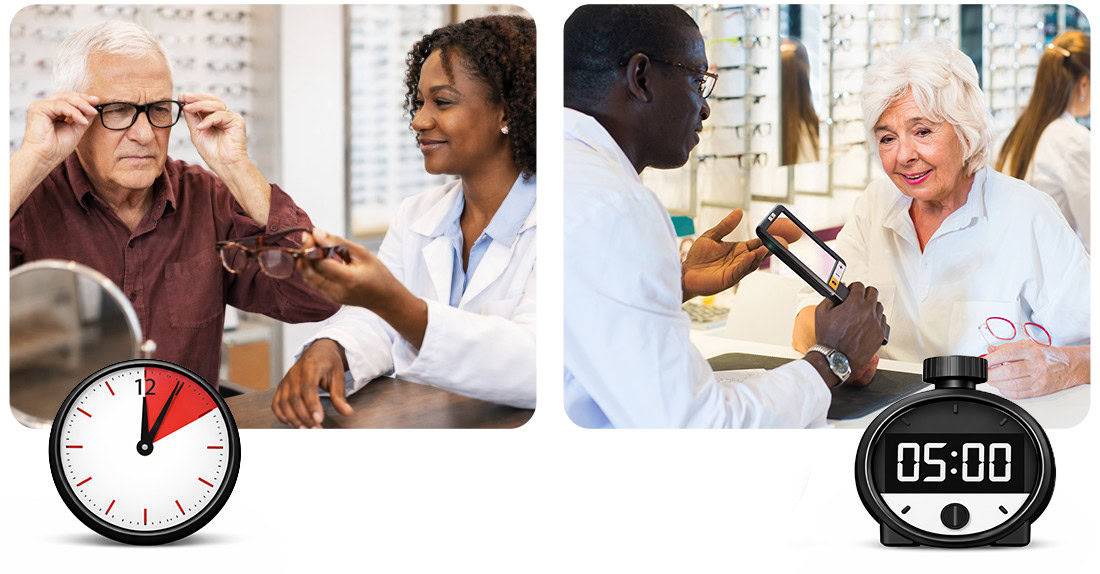
- A focused demonstration takes 5–10 minutes
- Showing one or two everyday tasks (mail, labels, phone screens) is usually enough
- Patients recognize the value almost immediately when they try the device themselves
It’s also important to put time into perspective:
It’s not uncommon for a patient to spend over an hour choosing a frame.
Compared to that, spending a few minutes on a functional, life-changing solution is not more time-consuming — and is often far more meaningful for the patient.
What makes demonstrations efficient:
- A simple, repeatable demo script
- A clear handoff from the exam room to the optical area
- A focus on real-life outcomes, not technical features
For optometrists, this means recommending a solution without extending exam time.
For opticians, it’s a natural extension of translating clinical findings into practical, everyday solutions.

Myth no. 2: “It’s not profitable”
Reality: Digital magnifiers can be one of the most sustainable categories — clinically and financially.
From a business perspective, digital magnifiers:
- Address a high functional need
- Are less exposed to online price competition
- Often deliver healthy margins
But profitability isn’t just about numbers — it’s also about reliability.
In the field, the data is clear:
- Digital magnifiers are robust and reliable
- Based on feedback shared in clinical settings, return rates for our electronic magnifiers are under 5%
- Breakage is rare when devices are properly demonstrated and supported
For the practice:
- Optometrists expand their scope of care without increasing clinical burden
- Opticians increase average transaction value through devices, accessories, and services
- Practices differentiate themselves as solution-driven, not prescription-only
Many practices also benefit from:
- Third-party funding, insurance support, or social programs (region-dependent)
- Increased referrals from caregivers, educators, and community organizations
The return on investment is shared across the entire practice — not owned by a single role.

Myth no. 3: “Patients won’t come back”
Reality: People with visual impairment are among the most loyal patients — when properly supported.
When glasses are no longer enough, patients often feel discouraged. Offering a next step builds trust and long-term engagement.
Low vision patients tend to:
- Return for follow-ups, adjustments, and accessories
- Maintain ongoing relationships as their vision evolves
- Refer family members and caregivers
For optometrists, this means continuity of care.
For opticians, it means long-lasting relationships, beyond eyewear replacement cycles.
Retention is driven by experience and support — not just purchase frequency.
A team-based opportunity
Low vision care works best when:
- Optometrists identify needs and recommend solutions
- Opticians or technicians demonstrate devices and provide ongoing support
- The practice presents a unified, patient-centered approach
As vision loss increases with aging populations, digital magnifiers are no longer a niche offering — they are becoming an expected part of comprehensive eye care.
Final thought
The real question isn’t:
“Who should handle low vision devices?”
It’s:
“What happens when a patient needs more than glasses — and the practice has nothing else to offer?”