
Reading a label, identifying an object or asking for a description of a room: AI smart glasses offer a hands-free way to access visual information. For people who are blind or have low vision, these everyday uses are drawing attention to a technology originally developed for a mainstream audience.

Ray-Ban Meta and Oakley Meta glasses combine a camera, microphones and open-ear speakers with an AI assistant. Users can ask questions about what is in front of them and hear a response without holding up a phone.
Personal accounts illustrate what this can mean in daily life. Research is also beginning to examine how reliably the glasses perform specific tasks. Together, they offer a clearer picture of the technology’s potential and its current limitations.
A 2026 pilot study published in JAMA Ophthalmology evaluated Ray-Ban Meta glasses on tasks involving objects, colours, text and US currency.
These findings suggest that recognizing an object can be easier for the system than interpreting precise details.
The study also has an important limitation: six study authors performed the tests in a controlled setting. It did not evaluate everyday use by blind or low-vision participants. The results describe performance under the tested conditions, rather than overall reliability in daily life.
A separate 2025 study in the Indian Journal of Ophthalmology examined a different AI-powered device designed for people with vision loss. Ninety participants from five rehabilitation centres in India used it for a month. Positive experiences were most common for reading, reported by 72.9% of participants, compared with 22.4% for walking assistance.
Those percentages reflect user feedback, not recognition accuracy. The study adds a complementary perspective on how people experience the technology, but its results should not be treated as a performance assessment of Ray-Ban Meta glasses.



Ray-Ban Meta and Oakley Meta glasses offer hands-free calling, messaging and content creation. For people who are blind or have low vision, they also provide spoken descriptions of their surroundings and, through third-party services, connections to sighted volunteers for real-time assistance.
Personal experiences show what this can mean in daily life. Writing for Consumer Reports, recording artist and disability advocate Lachi, who is legally blind due to coloboma, described using Ray-Ban Meta glasses to interpret scenes and read street signs during her travels. She also encountered ambiguous answers, highlighting the value of confirming important details.
In the American Foundation for the Blind’s AccessWorld, Aaron Preece described using the glasses while sorting groceries and clothing. As someone who is blind, he found that asking a specific question, such as requesting the text on a product label, produced more useful information than simply asking what he was holding.
For Martin, a Macular Society staff member born with sight loss, the appeal included accessing information without repeatedly positioning a phone. He also valued wearing a familiar consumer accessory.
Together, these accounts illustrate how wearable AI can make information easier to access, with thoughtful questions and human assistance helping users get more from the experience.
The type of assistance also matters. Wearable systems that enhance remaining vision have been studied in people with age-related macular degeneration (AMD). A 2025 trial found improved self-reported visual ability, but participants generally preferred their existing solutions. This underlines the importance of trying a device in everyday situations.
For people with advanced retinitis pigmentosa or cone-rod dystrophy, a small clinical study of OrCam MyEye 2.0 found benefits primarily related to reading. Separately, researchers have explored electronic glasses that compensate for tunnel vision associated with retinitis pigmentosa. These are different technologies, and their findings should not be interpreted as evidence that consumer AI glasses provide reliable navigation.
For people who are blind, spoken text and descriptions offer another way to access visual information, as Preece’s experience illustrates. The practical question is which tool provides useful information for the person’s vision, preferences and daily activities.
Convenience does not guarantee accuracy. AI can misinterpret images or give confident answers when information is incomplete. In Lachi’s experience, the glasses selected a flight from an airport departure board without acknowledging several possible matches. The answer happened to be correct, but it illustrates why important details need confirmation.
Users may need to adjust their question or camera angle to get a more useful response. Connectivity, accessible controls and privacy settings also shape the experience. Understanding these limitations helps users decide which tasks the glasses can support and when to seek confirmation.
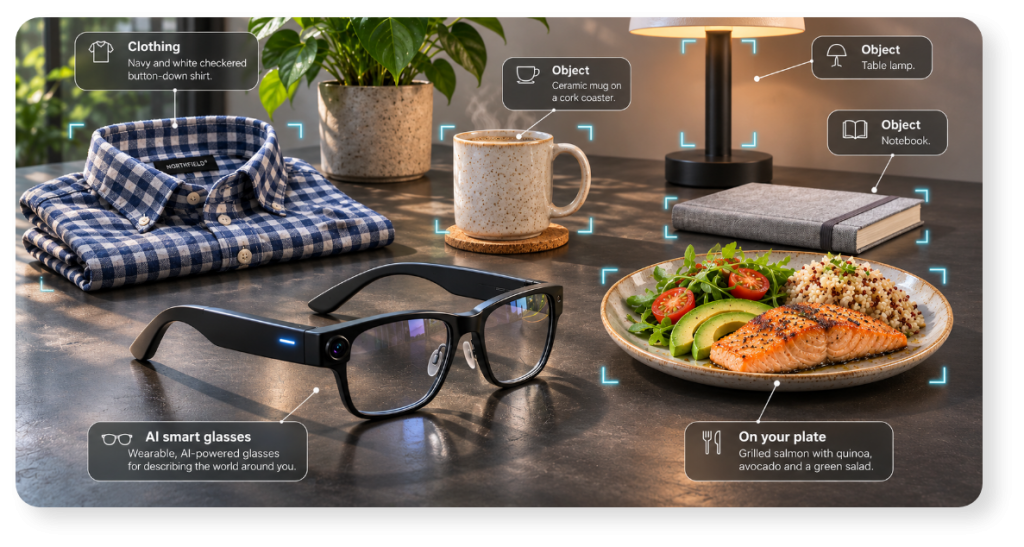
At breakfast, someone may want to magnify the print on a cereal box or ask for its label to be read aloud. At a restaurant, they might ask the glasses to read menu items and prices. These everyday tasks can become easier when information is available without repeatedly positioning a phone or asking someone for help. Vision Australia’s accessibility guide to Ray-Ban Meta glasses lists voice prompts such as “look and read” for visible text, including signs, menus and documents.
When getting dressed, a user might ask about a shirt’s colour or pattern. At a meal, they could request a description of what is on their plate, using clock-face positions to explain where each food is located. Follow-up questions let them focus on the details that matter to them. The same guide lists prompts such as “look and give me a detailed description” for a fuller picture of what is in view.
In an unfamiliar place, a user can ask for a description of the room or the number on a building’s door. Reading a building number may help confirm an address, but knowing which way to turn next requires navigation support. Different situations may call for different tools.
These examples also show why reliability matters. A misidentified shirt colour has different consequences from an incorrect street sign. Evaluation should consider how consistently a device works, how much effort it requires and how easily a user can detect an error or confirm an answer.
The findings point to useful questions for future development. Which tasks work reliably outside a controlled setting? How should the system communicate uncertainty? What information do users need, and when?
At HumanWare, we see an opportunity to bring specialized accessibility expertise to widely available wearable technology. Applications designed around specific needs could make the hardware more useful in everyday situations.
Blind and low-vision users must help shape that work. Their experience is essential to deciding what developers should improve and how assistance should fit into daily life.
AI smart glasses already offer new ways to access visual information. Their continued value will depend on reliable performance, thoughtful software and development guided by the people who use them.