AI and low vision at work: How Prodigi brings possibilities in vocational rehabilitation
Home / News / Blogs / AI and low vision at work: How Prodigi brings possibilities in vocational rehabilitation
What is vocational rehabilitation for people with vision loss?
Vocational rehabilitation (VR) helps people with vision loss prepare for, return to, or maintain employment by providing training, assistive technology, and workplace support.
For people with low vision, VR programs focus on:
– Access to digital and printed information – Assistive technology training – Job readiness and career transitions – Workplace accommodations
As workplaces become more digital and information-driven, VR is fast evolving too.
Evolution from access to productivity in low vision employment
Today’s workplace moves quickly. Information is constant. Expectations are high. For people with vision loss, the challenge is no longer just accessing information—it’s keeping up with it efficiently throughout the workday.
For years, assistive technology focused on a single question: Can the person read this? Today, that’s no longer enough.
The real question is: Can they work efficiently with that content in real-world conditions?
Modern workplaces demand speed, comprehension, and independence. This is why vocational rehabilitation professionals are under increasing pressure to deliver tools and strategies beyond access—supporting productivity, endurance, and long-term job retention.
And it’s exactly why AI is becoming essential—not optional—in low vision workflows.
“The challenge is no longer just accessing information—it’s keeping up with it efficiently throughout the workday.”
Why AI-powered assistive technology is transforming low vision work environments
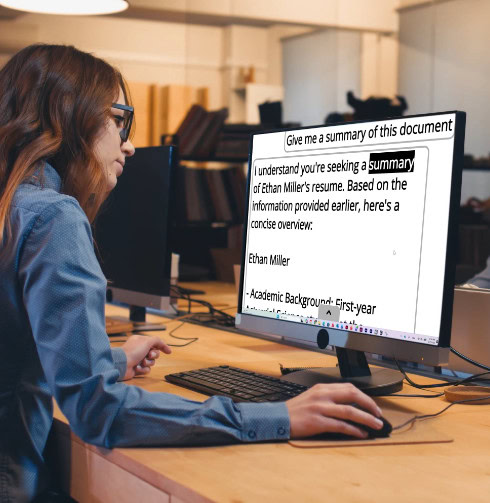
AI-powered assistive technology allows to do more than read—it helps them understand and process information faster by:
– summarizing long documents – extracting key information – getting answers instantly
For VR specialists, this means clients can process information at a pace that aligns with real job expectations—a critical factor in long-term employment success.
What is Prodigi for Windows and how does it support vocational rehabilitation?
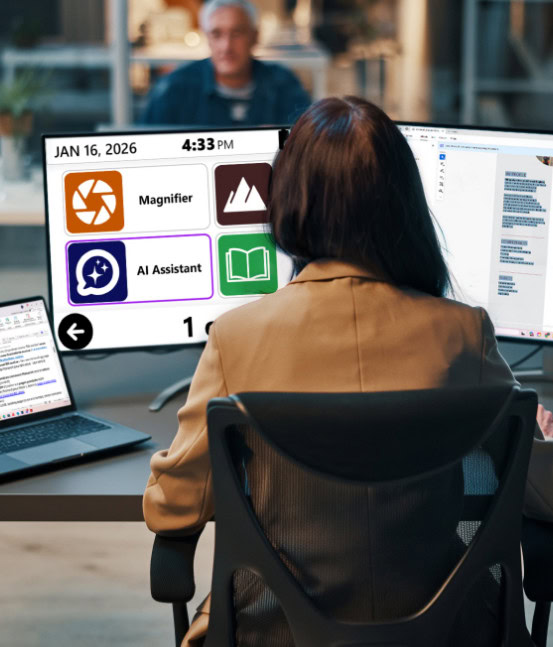
Prodigi for Windows is a low vision software solution that combines:
Magnification
Zoom and adjust contrast for comfortable reading.
OCR
Convert printed text into accessible digital content.
Text-to-speech
Listen to text with natural-sounding voices.
AI-assisted
Summarize, explain, and simplify complex information.
It is designed for use in training, rehabilitation, and workplace environments. By integrating multiple functions into one platform, it helps users:
– Read both digital and printed documents – Reduce visual fatigue – Improve comprehension and task efficiency
A practical solution for real-world training: low vision software for vocational rehabilitation and job readiness
One of the biggest challenges in vocational rehabilitation is ensuring that training translates into real-world success. Using multiple tools can create confusion and slow learning.
With an integrated solution like Prodigi:
– Clients learn one system – Skills transfer directly to the workplace – Confidence increases during training
This continuity is critical for reducing drop-off after job placement.
Connecting low vision tech to real job demands: Assistive technology for different work functions
Vocational rehabilitation professionals are not just selecting features—they are aligning tools with real job demands. To do this effectively, it’s essential to understand how technology supports different employment pathways.
Office and administrative jobs for people with low vision
These roles rely on reading reports, navigating spreadsheets, and managing structured digital information. Tools must enable clear, efficient reading and smooth interaction with everyday business documents.
Technical and data-driven careers (including STEM roles)
In fields like engineering, finance, or IT, access to graphs, charts, and diagrams is critical. The ability to interpret complex visual data often determines whether a role remains accessible.
Training and reskilling programs for vision loss
In vocational training and certification programs, individuals need to access materials, complete coursework, and build confidence using the same tools they’ll use on the job. Consistency supports long-term success.
Remote work accessibility for people with low vision
Remote work requires participation in meetings, navigation of shared documents, and real-time collaboration. Tools must support seamless transitions between tasks without slowing the user down.
How integrated assistive technology improves employment outcomes
Across all work environments, one principle remains constant: fast, flexible access to digital and technical content is key to employment success.
Today, it’s not just about accessing information—it’s about interacting with it efficiently throughout the workday. The ability to move between reading, listening, and understanding directly impacts productivity, endurance, and job retention.
Integrated solutions like Prodigi for Windows simplify this process by combining multiple tools into one streamlined workflow. This reduces fatigue, improves efficiency, and creates consistency from training to employment.
For vocational rehabilitation programs, it means better alignment with real workplace demands—and stronger, more sustainable outcomes.
“Today, it’s not just about accessing information
—it’s about interacting with it efficiently throughout the workday.”
The bottom line: with low vision tech comes sustainable and successful employment
Vocational rehabilitation isn’t about access alone—it’s about sustainable employment. AI-powered tools like Prodigi help close the gap between training and real-world performance by enabling users to work faster, smarter, and more independently. And for professionals supporting that journey, that’s what matters most.
Experience Prodigi for FREE Start 14 days trial
Reading and daily tasks require more effort.
Experience how Prodigi improves reading, productivity, and independence.