
Smart wearables are quickly shifting from “cool consumer tech” to something much more meaningful: everyday tools that can support independence, confidence, and participation. For people who are blind, smart glasses can play a valuable role in daily life by providing quick access to information and context in real-world situations. That matters to everyone in our community, including users, families, resellers, partners, and employees, because it shows how mainstream technology can contribute to accessibility beyond the classroom or training environment.
In the final See Things Differently with HumanWare episode of 2025, the conversation offered a grounded, practical look at how smart glasses, specifically Ray-Ban Meta smart glasses, are already being used as assistive technology. Not as a futuristic concept, but as tools people use right now for everyday decisions such as shopping, navigating public spaces, and building independence skills.
These stories reinforce a simple truth: no single solution works for every person or every moment. Smart glasses are not a replacement for existing tools, but they are becoming an increasingly valuable option in the broader assistive technology toolbox.
How smart glasses can support independence for people who are blind
One of the most memorable moments in the episode came from Gemma Gatehouse, a parent in Tasmania raising three children who are blind. She shared that her daughter Lily, who is nine years old, uses Ray-Ban Meta smart glasses and genuinely enjoys them.
“She’s got the Ray-Ban glasses… and she absolutely loves them.”
For Lily, the glasses are not a novelty. They help her access information quickly and make confident choices, especially while shopping. Gemma describes how Lily uses the glasses to better understand her surroundings in a store:
“So, she uses the glasses to go shopping and she’ll go, you know, ‘hey, mirror, what’s in front of me? Explain this doll to me… Show me where I am in the shop then.’”
Shopping is a powerful example because it is a real-life skill that combines independence, decision-making, and confidence. Smart glasses can support people who are blind by helping them identify items, confirm details, and understand what is around them, reducing reliance on others and encouraging self-determination. This can be especially meaningful for children and teenagers who are learning how to navigate the world on their own terms.
How smart glasses can help in unfamiliar environments
Smart glasses can also be useful in situations where environments are unfamiliar or constantly changing. This includes busy transit stations, unfamiliar buildings, crowded shopping centers, or spaces where layouts change frequently.
Co-host David Woodbridge shared how he uses Ray-Ban Meta smart glasses while traveling:
“I use the Ray-Bans to find out where I’m on the railway station because sometimes I can’t find the stairs.”
Even with strong orientation and mobility skills, real-world navigation can be complex. David also shared a moment that many guide dog users will recognize:
“My beloved guide dog will confidently go off in the wrong direction, right?”
This is not a criticism of guide dogs or mobility tools. It reflects everyday reality. Canes and guide dogs support safe travel, but there are moments when additional context is helpful. Smart glasses can provide that extra layer of information, such as confirming directions, locating stairs, or identifying entrances.
For people who are blind, this can increase confidence, especially when traveling independently.
Why smart glasses are gaining attention now
There are several reasons smart glasses are gaining attention in accessibility conversations.
They are hands-free, which matters when someone is using a cane, holding a guide dog harness, carrying bags, or navigating stairs. They support real-time decision-making, which is essential when barriers appear unexpectedly, such as identifying a product, locating a landmark, or understanding what is directly ahead. They also look like mainstream consumer technology, which can make them more comfortable to wear in public for people who prefer tools that do not feel medical or specialized.
This growing interest is also reflected in broader technology and accessibility discussions. In a recent video conversation about emerging consumer tech and accessibility trends, smart glasses are highlighted as a category to watch as capabilities, design, and public adoption continue to evolve.
During the holiday recommendations segment of the podcast, David summed up his enthusiasm simply:
“One of my favorite things… the Ray-Ban glasses.”
He also hinted at what many in the technology world are predicting:
“Considering what’s going to happen with smart glasses… next year in particular, I’d say jump on the bandwagon.”
While not everyone will choose to use smart glasses, their increasing availability and visibility suggest they will continue to play a growing role in how accessibility solutions evolve.
Smart glasses add options without replacing existing tools
It is important to be clear that smart glasses are not meant to replace mobility training, braille, or the tools people already trust. Instead, they can complement existing strategies and support people who are blind in specific situations.
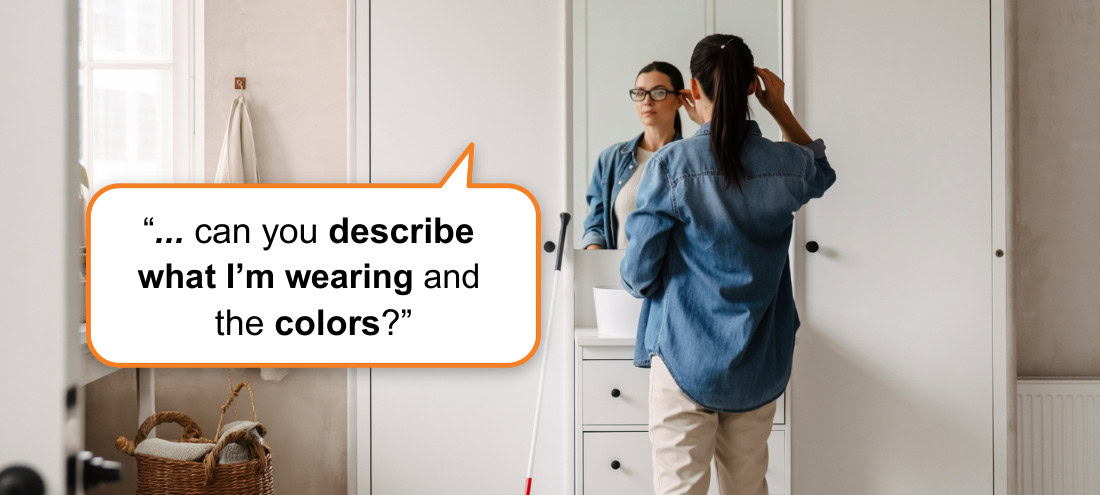
For example, smart glasses may help with quick descriptions of what is in front of someone, identifying items while shopping or exploring, orientation support in unfamiliar environments, and confidence in moments when asking for help feels inconvenient or exhausting.
Gemma captured a practical and thoughtful approach to assistive technology adoption:
“We just try to incorporate whatever we can into their day and, you know, give them as much tools as we can. Anything in your toolbox. If it works, it works. If it doesn’t, you can find another one and go for it.”
This mindset reflects an important principle. Assistive technology is personal. What works well for one person may not fit another person’s routine, preferences, or needs, and that is okay. Progress comes from having more meaningful options.
What this means for the blind community
As smart glasses continue to evolve, they are likely to become part of more people’s everyday technology setups, alongside smartphones, braille displays, notetakers, GPS apps, and mobility tools.
For people who are blind, this can mean greater access to information and more independence in daily decision-making. For families, it can offer new ways to support confidence without taking control. For our resellers and partners, smart glasses represent a growing category that deserves thoughtful understanding and positioning. For employees and the broader accessibility community, they are another reminder of how quickly accessible technology is changing and why real user experiences must remain at the center of the conversation.
For people interested in trying smart glasses themselves, HumanWare now distributes Ray-Ban Meta smart glasses in Canada and the United States, making them available through our site and select authorized distributors.
Explore available smart glasses in the HumanWare store.