What happens when blind students can access braille and tactile graphics instantly—just like their peers?
Home / News / Blogs / What happens when blind students can access braille and tactile graphics instantly—just like their peers?
Braille literacy and accessibility in STEM: What the Monarch pilot project shows
For many students, literacy is more than reading—it’s independence, confidence, and full participation in the classroom. Yet in today’s learning environments, where digital content moves quickly—especially in Science, Technology, Engineering, Arts and Mathematics (STEAM)—access doesn’t always keep pace. Tactile graphics are often delayed, simplified, or unavailable in real time, leaving blind students a step behind.
The Monarch Student Pilot Project explores what changes when that barrier is removed.
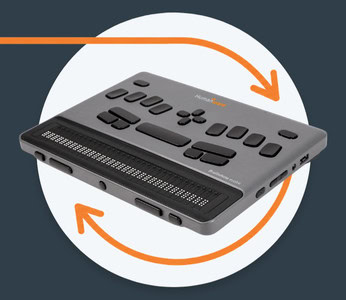
Launched in August 2024 by the American Printing House for the Blind (APH), in partnership with HumanWare, the project provides Monarch devices on long-term loan to braille-reading middle and high school students and their families. Through ongoing feedback from students and educators, the project is helping identify what supports learning—and what still needs improvement.
In its first year, 115 students participated. By August 2025, an additional 110 students joined, bringing total participation to over 200 students nationwide in year two.
When access increases, participation follows
When blind students can read and reference information independently, they can engage in class like their peers.
They can join discussions, follow lessons in real time, and work without constant adult support.
Among students using Monarch in the classroom, nearly 70% said it made classes more enjoyable—across both STEAM and non-STEAM subjects. Educators also observed that about half of students showed increased engagement and improved proficiency once Monarch became part of their daily learning.
This matters because enjoyment in learning is not just a “nice-to-have.” It’s a key driver of persistence, confidence, and long-term literacy—especially for students who have historically faced barriers.
A middle school student described the impact simply:
“She is immersed in the class and works alongside her peers without needing 1:1 assistance from an adult.”
How the Monarch builds braille literacy and engagement
Strong literacy skills develop through consistent access and use. When students can read more, practice more, and explore information independently, their interest and skill increase.
Since introducing Monarch, educators observed:
43%
increase in student interest in reading
64%
increase in interest in braille
93%
increase in engagement with tactile graphics
A high school student shared:
“It has really helped to increase my reading speed and make a jump in proficiency that I think would have been slower on another display or paper braille.”
Tactile graphics in real time: Closing the accessibility gap
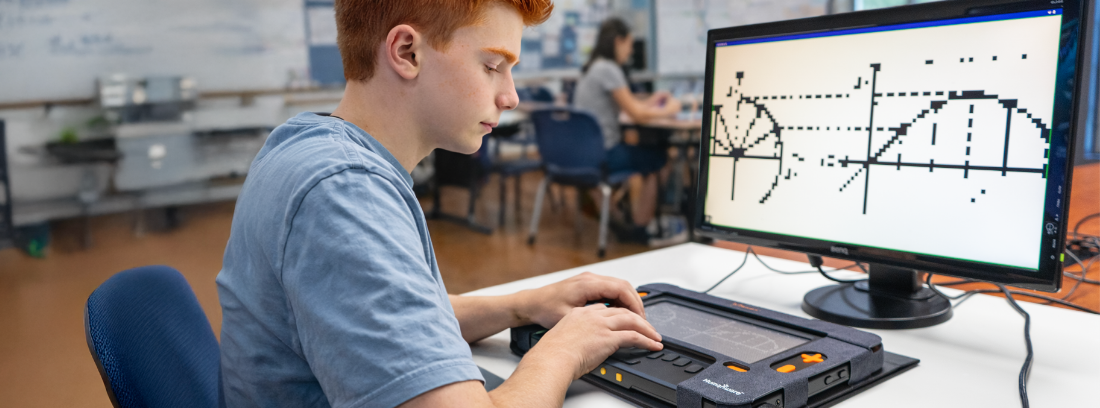
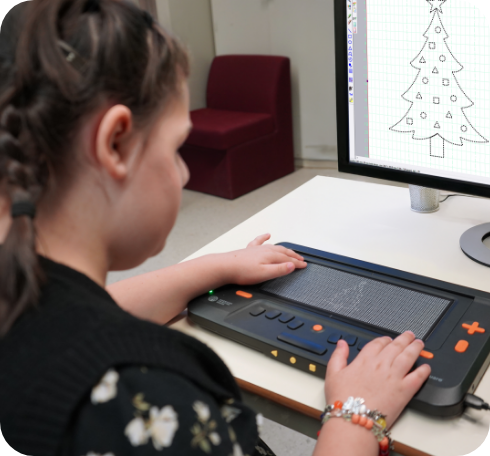
Tactile graphics often make the difference between hearing about a concept—and truly understanding it.
In many classrooms, blind students still have to wait for embossed materials or rely on simplified alternatives. These delays can unintentionally send the message that full access is optional.
With Monarch, students in the Pilot Project reported meaningful improvements:
76% said they had greater access to tactile graphics
Nearly 70% said they learned something new thanks to that access
Over 60% said they could explore subjects or materials that were previously inaccessible
Students described the experience as transformative:
“Before, I had to wait for my teacher to print out a graphic. Now I can find it myself.”
“It made me feel like I could finally achieve something with pictures.”
How braille access supports independence beyond the classroom
The blind and low vision community has long emphasized that braille is freedom. Access goes far beyond academics—it shapes what students believe is possible for their future.
Educators shared stories of students reading with family members, participating in shared activities, and exploring new possibilities.
One educator wrote:
“He has been reluctant to explore the idea of attending higher education, but… he can now see that it is a possibility with the Monarch.”
These outcomes point to something bigger than a single device. When students have tools that support literacy and independence, they gain the confidence to set higher goals—and pursue them.
Supporting educators: more teaching, less formatting
Educators who integrated Monarch into their curriculum reported a 30–35% reduction in lesson preparation time.
This allows them to focus more on teaching—and less on formatting, workarounds, and production delays.
What this means for braille literacy and equality
The Monarch Student Pilot Project reinforces a long-standing truth: braille literacy and meaningful tactile access are essential to independence and equality.
When students can access the same materials at the same time as their classmates, they gain more than information. They gain a sense of belonging—and greater opportunities for the future.
As one educator shared:
“The Monarch will make a huge difference in the life of each student who receives one. For this student, it might just be completely life changing.”